
Why did not Jesus Christ write a single jot of his teachings down on parchment? How come He did not command His Apostles to write anything down? And, yet, we have this collection of books called the Holy Bible that most every Christian reveres as the written Word of God. Many of those Christians claim that it is only through the Bible that we received divine revelation; and, that all matters of faith (doctrine) and morals should be promulgated and confessed strictly and solely by, with, and through the Holy Bible.
I very recently asked a good Christian friend of mine this question: who was responsible for compiling the Bible? In other words, how did we get the Bible in the format that we have today? I received no answer. Now, this is not to denigrate my friend, or anyone else for that matter, but this question should at least provoke some degree of curiosity in the minds of Christians who do not know how the Holy Bible came to be, especially for any Christian who puts much of their faith into a collection of books subscribing it to be the very written Word of God.
Henry Graham poses these questions regarding the Holy Bible:
“Are you sure that your Bible contains exactly the words, and all the words, and only the words, that came from the hands of the apostle and evangelist? Are you sure that no other words have crept in or that none have dropped out? Can you study the Hebrew and Greek and Latin manuscripts and versions, page by page, and compare them, and compile for yourself a copy of Holy Scriptures identical with that written by the inspired authors from Moses to John?…
You know perfectly well that you must trust some authority outside of yourself to give you the Bible. The Bible you are using today was handed down to you. You have, in fact, allowed some third party to come between you and God.”
That minister, parent or grandparent, and/or any other person that gave you a copy of your own Holy Bible – I will let you in on a little secret – they did not put that collection together, and from whomever they received it, that person also did not compile the Scriptures. Furthermore, why and how do you trust those who handed you a Bible informing you that it was the written Word of God?
Nowhere in all of Scripture does it self-authenticate as being the Word of God. No prophet or apostle signed off their writings as being the inspired Word of God. You will not even find the term ‘Holy Bible’ in the Holy Bible. So, the question remains, who is responsible for compiling the Holy Bible?
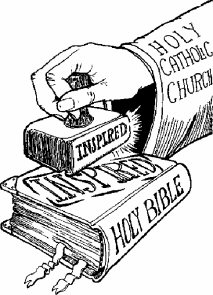
Anytime a Christian, or non-Christian for that matter, opens up his or her Bible, regardless of the translation/version, they are, whether they like it or not, giving heed to the authority of the Catholic Church. Yes, the Catholic Church alone is responsible for compiling the definitive canon of the Holy Bible, Old and New Testament. It was the Catholic Church that promulgated which books belonged as the inspired, inerrant written Word of God, and which books did not belong.
It was in 382 A.D., at the Council of Rome, during the reign of Pope Damasus I, that the books of the Holy Bible were formally promulgated:
“Now indeed we must treat of the divine Scriptures, what the universal Catholic Church accepts and what she ought to shun. The order of the Old Testament begins here: Genesis one book, Exodus one book, Leviticus one book, Numbers one book, Deuteronomy one book, Josue Nave one book, Judges one book, Ruth one book, Kings four books, Paralipomenon [i.e. Chronicles] two books, Psalms one book, Solomon three books, Proverbs one book, Ecclesiastes one book, Canticle of Canticles one book, likewise Wisdom one book, Ecclesiasticus [i.e. Sirach] one book.
Likewise the order of the Prophets. Isaias one book, Jeremias one book, with Ginoth, that is, with his Lamentations, Ezechiel one book, Daniel one book, Osee one book, Micheas one book, Joel one book, Abdias one book, Jonas one book, Nahum one book, Habacuc one book, Sophonias one book, Aggeus one book, Zacharias one book, Malachias one book. Likewise the order of the histories. Job one book, Tobias one book, Esdras two books [i.e. Ezra & Nehemiah], Esther one book, Judith one book, Machabees two books.
Likewise the order of the writings of the New and Eternal Testament, which only the holy and Catholic Church supports. Of the Gospels, according to Matthew one book, according to Mark one book, according to Luke one book, according to John one book.
The Epistles of Paul the Apostle in number fourteen. To the Romans one, to the Corinthians two, to the Ephesians one, to the Thessalonians two, to the Galatians one, to the Philippians one, to the Colossians one, to Timothy two, to Titus one, to Philemon one, to the Hebrews one.
Likewise the Apocalypse of John, one book. And the Acts of the Apostles one book. Likewise the canonical epistles in number seven. Of Peter the Apostle two epistles, of James the Apostle one epistle, of John the Apostle one epistle, of another John, the presbyter, two epistles, of Jude the Zealut, the Apostle one epistle.”
– Decree of the Council of Rome (AD 382) on the Canon of Scripture during the reign of Pope Damasus I (AD 366-384).
Are you are having some initial trouble with this undisputed, historical fact? Just read what Martin Luther had to say about who gave us the Scriptures:
“We are compelled to concede to the Papists that they have the Word of God, that we received it from them, and that without them, we should have no knowledge of it at all.” – Martin Luther, Luther’s Sermons on John 16 [LW 24].